Switching actuator, 2-gang / blind actuator, 1-gang 16 A with binary input, 3-gang for Gira One and KNX

Specification
Item no.
Room
Quantity
EAN
PU
PS

Flush mounted
5062 00
4010337099253
1/5
Price system (PS) not equal to 1, 14 = reduced discount.
Note: For legal reasons, some products are not available in certain countries.
Flush mounted
EAN 4010337099253
Item no. 5062 00PU 1/5
PS
Price system (PS) not equal to 1, 14 = reduced discount.
Note: For legal reasons, some products are not available in certain countries.
Optional accessories
Zubehör
Accessories
Alarm devices and sensors
Features
Function in the Gira One system
- Actuator for switching devices or for controlling blinds, shutters, awnings, skylight operation.
- In blind operation, the adjacent outputs (A1/A2) are combined into one blind output.
- 3 binary inputs for connection to conventional switches, buttons and motion detectors with zero-voltage contacts.
- Connection to an external temperature sensor at input 3.
- The inputs are used to control Gira One actuators or to record status information.
- Programming and start-up with the Gira Project Assistant (GPA), from version 5.0.
- Encrypted data transfer between the Gira One devices.
Shading and ventilation functions
- Control of slat blinds, shutters, awnings, skylights or roof domes.
- Runtimes optionally adjustable.
- Sun protection function with curtain or slat positions at the beginning or end of the function that can be set for each output.
- Setting of the delay time at the beginning or end of the sunshine.
- Fabric stretching for awnings.
- In the event of an active wind alarm, e.g. with a conventional weather station with zero-voltage relay outputs for the wind alarm, the blinds raise and are automatically locked. The status of the binary input is monitored on a cyclical basis.
- In the event of an active rain alarm, e.g. with a conventional weather station with zero-voltage relay outputs for the rain alarm, the skylights or roof domes close immediately and are automatically locked. The status of the binary input is monitored on a cyclical basis.
- In the event of an active frost alarm, e.g. with a conventional weather station with zero-voltage relay outputs for the frost alarm, the active movements of shutters are stopped and locked to protect the shutter motor. The status of the binary input is monitored on a cyclical basis.
- Door contact query and visualisation in the Smart Home App: An open door results in the raising and locking of the blind or shutter.
Switching functions
- NO contact or NC contact operation.
- Setting of a switch-on or switch-off delay.
- Staircase function; a pre-warning time can also be set.
- Parameterisation as a switching function for lights or socket outlets, a garage door function or a door opener function, for example, as well as a switching contact for transmitting the heating requirement to a heat pump.
- Garage door function: The time for closing the relay can be parameterised.
- Door opener function: The time for closing the relay can be parameterised.
Binary inputs
- Single and double-surface operation can be configured for rocker buttons.
- Connection of rocker buttons parameterised with switching, dimming, shading and ventilation, scene call-up, staircase (motion detector), floor call with Gira G1, garage door and door opener functions.
- Connection of movement and presence detectors with zero-voltage relay outputs.
- Convenient group control of switching, dimming, shading and ventilation devices.
- Switching contact evaluation of wind, frost, brightness or rain sensors possible with zero-voltage relay contacts, in order to protect shading and ventilation devices from environmental influences.
- Window contact query and visualisation in the Smart Home App: An opened window will result in the activation of the frost protection heating mode after a 5 minutes has elapsed.
- Door contact query and visualisation in the Smart Home App: An open door results in the raising and locking of the blind or shutter.
- Query regarding a heating/cooling switchover on a heat pump, to allow the current operating mode (heating or cooling) to be forwarded to the heating controller.
- Switching contact display to show contact status in the Smart Home app.
- Configurable switching inputs that can be independently parameterised.
- Recording and comparison of temperature values via remote sensors (see accessories) at input 3.
Function in the Gira KNX system
- Blind or switching operation can be parametrised. In blind operation, both outputs (A1/A2) are combined into one blind output.
- Device has three inputs with a common reference potential.
- Read-in of switching states of installation switches or buttons and other zero-voltage contacts at inputs 1 to 3.
- Signal analysis of dew and leakage sensors (see accessories) at inputs 1 to 3.
- Recording of temperature values via remote sensors (see accessories) at input 3.
- Up to 8 independent logic functions for implementing simple or complex logical operations.
- Actively transmitting feedback or status messages can be delayed after a bus voltage recovery or ETS programming mode.
- Bistable relay.
Blind functions
- Operating mode can be parametrised: Control of slat blinds, roller shutters, awnings, skylights or ventilation flaps.
- Separately parameterisable curtain runtimes with runtime extension for movements into the upper end position.
- For slat blinds, a slat runtime can be parametrised independently.
- Switchover time for change of direction and times for short and long-term operation (Step, Move) can be set.
- Reaction in case of bus voltage recovery can be set following an ETS programming process.
- Central control via up to 6 long-term objects possible (UP, DOWN, permanently UP, permanently DOWN).
- Feedback on the curtain or slat position. In addition, feedback on an invalid curtain position or a drive movement is possible. Active (send to the bus in case of change or cyclically) or passive (object can be read out) feedback functions.
- Assignments of up to five different safety functions (3 wind alarms, 1 rain alarm, 1 frost alarm), with cyclical monitoring as an option.
- Comprehensive sun protection function with fixed and variable curtain or slat positions at the beginning or end of the function can be activated. Including dynamic slat offset for slat blinds. Also with extended sun protection for integration in more complex shading control systems (has separate automatic and blocking objects). Optionally also with automatic heating/cooling and presence function.
- Fabric tensioning function for awnings.
- Extended blocking function with acknowledgement option.
- Ventilation function for windows with window contacts.
- Intelligent teaching function for curtain movement.
- Forced setting function or blocking function can be implemented.
- Up to 64 internal scenes can be parametrised.
- Scene memory function: Additional visual feedback.
- Extended scene retrieval (toggling of scenes).
Switching functions
- Independent switching of the switching outputs.
- NO contact or NC contact operation.
- Central switching function via up to 6 switch objects (ON, OFF, permanently ON, permanently OFF).
- Switching feedback: Active or passive feedback function.
- Reaction in case of bus voltage failure or bus voltage recovery can be set following an ETS programming process.
- Logical individual linking function for each output.
- Blocking function can be parametrised for each channel. Alternative separate forced setting function for each output.
- Extended blocking function with acknowledgement option.
- Time functions (switch-on and switch-off delay, staircase light function – also with advance warning function).
- Integration into light scenes possible: Up to 64 internal scenes can be parametrised per output.
- Scene memory function: Additional visual feedback.
- Extended scene retrieval (toggling of scenes).
- Elapsed operating time meter can be activated individually for each output.
- Input monitoring for cyclic updating of the switching object with safety position.
Technical data
| Rated voltage | DC 21 to 32 V SELV |
| Switching capacity | AC 250 V, 16 AX |
| Maximum switch-on current | 800 A (200 µs), 165 A (20 ms) |
| Gira One Medium | Twisted pair (TP),YCYM 2 x 2 x 0.8 |
| Test voltage | 4 kV (KNX/EIB bus line) |
| Connections | |
| Gira One Bus | Connection terminals to control line |
| Inputs | Connection terminals to control line |
| Load | Screw terminals |
| Connection cross section | Max. 4 mm² |
| Inputs | |
| Quantity | 3 |
| Input type | Zero-voltage |
| Sampling voltage | |
| Auxiliary inputs | Approx. 5 V |
| Total length | |
| Auxiliary input cable | Max. 10 m |
| Connected load | |
| Ohmic load | 2500 W |
| Capacitive load | 16 A, max. 140 µF |
| Motors (blind or fan) | 1380 W |
| Light bulbs | 2300 W |
| HV halogen lamps | 2300 W |
| Fluorescent lamps, parallel-compensated | 1160 VA |
| HV LED lamps | typically 400 W |
| Wound electronic transformer | 1200 VA |
| Tronic transformer | 1500 W |
| Fluorescent lamps, uncompensated | 1000 VA |
| Fluorescent lamps,lead-lag circuit | 2300 VA |
| Ambient temperature | -5 °C to +45 °C |
Notes
- Power reductionReduction of the switching current of each device (relative to Σ 16 A)
- 10% reduction for every 5°C above 35°C
- 15% reduction when installed in wood or drywall
- 20% reduction for multiple combinations. - Can be updated via the Gira Project Assistant (GPA)
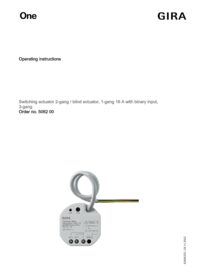
Switching actuator 2-gang / blind actuator, 1-gang 16 A with binary input, 3-gang for Gira One
Operating instructions.
Operating instructions.
Switching actuator 2-gang / blind actuator, 1-gang 16 A with binary input, 3-gang for KNX
Operating instructions.
Operating instructions.
Switching actuator 2-gang / blind actuator, 1-gang 16 A with binary input, 3-gang for KNX
Technical documentation.
Technical documentation.

Switching actuator 2-gang / blind actuator, 1-gang 16 A with binary input, 3-gang for KNX
from ETS5.7.3
from ETS5.7.3
Switching actuator, 2-gang / blind actuator, 1-gang 16 A with binary input, 3-gang for Gira One and KNX
PSTI Statement of Compliance
PSTI Statement of Compliance