Dimming actuator, 4-gang Komfort for KNX 4 x 225 W/VA

Specification
Item no.
GBP/unit
excl. VAT:
excl. VAT:
Room
Quantity
EAN
PU
PS

DRA
2025 00
473.40
4010337073338
1
26
Recommended retail price, prices valid for United Kingdom as of the stated date 01/26
Price system (PS) not equal to 1, 14 = reduced discount.
DRA
EAN 4010337073338
Item no. 2025 00PU 1
GBP 473.40PS 26
Recommended retail price, prices valid for United Kingdom as of the stated date 01/26
Price system (PS) not equal to 1, 14 = reduced discount.
Optional accessories
Features
- Dim actuator with integrated bus coupler.
- Switching and dimming of light bulbs, HV halogen lamps, dimmable HV-LED lamps, dimmable compact fluorescent lamps, dimmable inductive transformers with LV halogen or NV-LED lamps, dimmable electronic transformers with LV halogen or NV-LED lamps.
- Automatic or manual selection of dimming principle according to load.
- Idle-state, short-circuit, and excess temperature-proof.
- Manual actuation of the outputs independent of the bus.
- Temporary status display can be activated, link via communication object possible across several actuators.
- Parallel connection of several outputs for dimming higher lamp loads or power extension via power boosters.
- To simplify configuration, all existing dimming channels can be assigned to the same parameters in the ETS and hence identically parametrised.
- Up to 6 central functions for common control of all dimming channels with switching, dimming and value objects.
- Up to 8 independent logic functions for implementing simple or complex logical operations.
- Actively transmitting feedback or status messages can be delayed globally after a voltage recovery or ETS programming operation.
Dimming outputs
- Independent switching and dimming of the dimming outputs.
- The load type can be specified and the dimming principle defined: Universal (with automatic calibration procedure), electronic transformer (capacitive/trailing edge), conventional transformer (inductive/leading edge), LED (leading edge) or LED (trailing edge).
- Dimming characteristic curve per channel configurable in time and value range for adaptation to the respective connected load.
- Dimmable range can be set (switch-on brightness; basic brightness; alternatively: lower dimming limit and upper dimming limit).
- Performance on receipt of an absolute brightness value can be set (dimming, brightening, fading).
- Performance during relative dimming up in switched-off state can be set ( switch channel on, no reaction).
- Central control function using up to 6 switching objects, 6 dimming objects and 6 value objects and collective feedback.
- Switching feedback: Active (transmitting to the bus cyclically or when there is a change) or passive (object can be read out) feedback function.
- Brightness value feedback: Active (transmitting to the bus cyclically or when there is a change) or passive (object can be read out) feedback function.
- For active feedback objects, the type of update can be set (when the input object is changed or when the feedback value is changed). This allows visualizations to be adapted individually.
- Feedback signals for short circuit, overload/mains power failure and load type (KNX-compliant and extended).
- Reaction to bus voltage failure/recovery and after an ETS programming operation can be set for each output.
- Logical individual linking function for each output.
- Blocking function can be parametrised for each channel. Alternative separate forced setting function for each output.
- Time functions (switch-on delay, switch-off delay).
- Staircase light function with advance warning function via time-controlled reduction of lighting or activation of permanent lighting.
- Staircase function with time extension or variable staircase time allocation via communication object.
- Soft ON function and Soft OFF function can be set.
- Automatic switch-off can be set where brightness value < X % (with individual delay time).
- Integration into light scenes possible: Up to 64 internal scenes can be parametrised per output.
- Delay time for scene retrieval can be configured.
- Dimming performance can be set when a new scene is called up (brightening, dimming, fading).
- Visual feedback when saving a scene.
- Extended scene retrieval.
- Elapsed operating time meter can be activated individually for each output.
- Elapsed operating time meter as forward meter (with optional threshold value) or backward meter (with optional starting value).
Logic functions
- The device has 8 internal logic functions.
- Logic gate (AND, OR, exclusive AND, exclusive OR, each with up to 4 inputs).
- 1-bit to 1-byte converter with input filter, blocking object and specification of output values.
- Blocking element with filter and time functions and blocking object.
- Comparator for values with 9 different input data formats and many comparison operations.
- Limit value switch with hysteresis with upper and lower threshold values for 9 different input data formats. Including specification of the 1-bit output values.
- The logic functions have their own KNX communication objects and can process telegrams from the actuator or other bus devices.
Technical data
| KNX medium | TP256 |
| Rated voltage | AC 110 to 230 V, 50/60 Hz |
| Max. connected load (AC 230 V) per channel | |
| Light bulbs | 20 to 225 W |
| HV halogen lamps | 20 to 225 W |
| Wound electronic transformer | 20 to 210 VA |
| Tronic transformer | 20 to 225 W |
| Wound transformer with NV-LED | 20 to 100 VA |
| electronic transformer with NV-LED | typically 20 to 200 W |
| HV LED lamps | typically 1 to 200 W |
| Compact fluorescent lamp | typically 20 to 150 W |
| Connections | |
| KNX | Connection and junction terminal |
| Load | Screw terminals |
| Connection cross section | Max. 4 mm² |
Notes
- VDE approval in accordance with EN 60669-1, EN 60669-2-1.
- The maximum connected load depends on the operating mode selected (leading edge or trailing edge). You will find more detailed information in the operating instructions.
- Power expansion using Gira power boosts.
- Only use up to 95% of the capacity of outputs connected in parallel. Do not connect compact fluorescent lamps to dimming outputs connected in parallel. Do not extend dimming outputs connected in parallel with power boosters.
- Installation on DIN top-hat rail.
- KNX Data Secure compatible.
- Fast application download (long frame support).
- Firmware can be updated using the Gira ETS Service App (additional software).
Scope of delivery
- Connection and junction terminal for KNX included with delivery.
Dimensions
| Modular widths (MW) | 4 |
More links
Gira dimming actuators for KNX
More

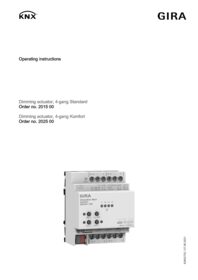
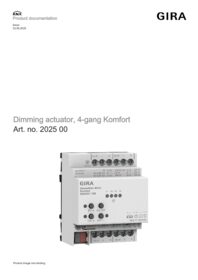


Dimming actuator, 4-gang Komfort for KNX 4 x 225 W/VA
PSTI Statement of Compliance
PSTI Statement of Compliance