System 106 Keyless In fingerprint module

Specification
Item no.
GBP/unit
excl. VAT:
excl. VAT:
Room
Quantity
EAN
PU
PS

stainless steel
5551 920
976.97
4010337072799
1
20

aluminium
5551 926
-
4010337072805
-
-

aluminium (anodised)
5551 916
799.65
4010337138044
1
20

traffic white (laquered)
5551 902
799.65
4010337072812
1
20

stainless steel V4A
5551 914
1,037.26
4010337112860
1
20

Bronze (PVD)
5551 921
1,037.26
4010337108252
1
20

black matt (lacquered)
5551 925
1,037.26
4010337108245
1
20
Recommended retail price, prices valid for United Kingdom as of the stated date 01/26
Price system (PS) not equal to 1, 14 = reduced discount.
stainless steel
EAN 4010337072799
Item no. 5551 920PU 1
GBP 976.97PS 20
aluminium
EAN 4010337072805
Item no. 5551 926PU -
-PS -
aluminium (anodised)
EAN 4010337138044
Item no. 5551 916PU 1
GBP 799.65PS 20
traffic white (laquered)
EAN 4010337072812
Item no. 5551 902PU 1
GBP 799.65PS 20
stainless steel V4A
EAN 4010337112860
Item no. 5551 914PU 1
GBP 1,037.26PS 20
Bronze (PVD)
EAN 4010337108252
Item no. 5551 921PU 1
GBP 1,037.26PS 20
black matt (lacquered)
EAN 4010337108245
Item no. 5551 925PU 1
GBP 1,037.26PS 20
Recommended retail price, prices valid for United Kingdom as of the stated date 01/26
Price system (PS) not equal to 1, 14 = reduced discount.
Necessary accessories
One of the following items:
System device for door communication
The Gira System 106 is an installation system made of metal in a puristic and elegant frameless design, based on basic measurements of 106.5 × 106.5 mm. With the modular door intercom in Gira System 106, hospitality begins even before you reach the front door. All the functions are presented in a harmonious overall appearance, from the call button module, intercom module, and camera module, up to the info and blank module. In the dark, backlit call buttons with inscription space ensure good legibility and an attractive appearance.
Individually adaptable modular system
The System 106 can be used in family homes or apartment buildings, as well as in office buildings, industrial properties, and hotels. The modular design enables the system's size, design, and functionality to be individually adapted to the respective requirements. Expansions and changes are possible at any time by easily exchanging the modules.
With this system, it is also possible to exchange the fronts only. This means that the appearance of the system can be changed from e.g. traffic white to a stainless steel surface at a later stage, without having to exchange the electronic units.
High-quality materials
The modules are frameless with design fronts made of genuine materials, available in two brushed stainless steel versions (V2A and V4A), anodised aluminium C-0, and a metal alloy lacquered in traffic white (RAL 9016): all robust materials which ensure durability. The camera and DIN 18040 display module feature a black glass cover.
Easy and phased installation
The system can be installed in phases, in parallel to the progress of building work. In this way, it is possible to initially install only the lower part of a surface-mounted housing during construction of the shell; cables and modules can then be added when they are needed.
Individual inscription options
Call button modules and info modules can be labelled individually via the Gira inscription service.
Individually adaptable modular system
The System 106 can be used in family homes or apartment buildings, as well as in office buildings, industrial properties, and hotels. The modular design enables the system's size, design, and functionality to be individually adapted to the respective requirements. Expansions and changes are possible at any time by easily exchanging the modules.
With this system, it is also possible to exchange the fronts only. This means that the appearance of the system can be changed from e.g. traffic white to a stainless steel surface at a later stage, without having to exchange the electronic units.
High-quality materials
The modules are frameless with design fronts made of genuine materials, available in two brushed stainless steel versions (V2A and V4A), anodised aluminium C-0, and a metal alloy lacquered in traffic white (RAL 9016): all robust materials which ensure durability. The camera and DIN 18040 display module feature a black glass cover.
Easy and phased installation
The system can be installed in phases, in parallel to the progress of building work. In this way, it is possible to initially install only the lower part of a surface-mounted housing during construction of the shell; cables and modules can then be added when they are needed.
Individual inscription options
Call button modules and info modules can be labelled individually via the Gira inscription service.
Features
- Fingerprint module as a professional, biometric access control system based on next-generation surface scanning technology.
- Start-up and administration via app.
- Use as a stand-alone device with Gira DCS switching actuators or in combination with the Gira door communication system as a door call system for buildings with several residential units.
- Scanning the deepest layer of skin using high frequency. High detection rate and security against tampering.
- An evaluation of the unique characteristic features of the living human finger.
- Up to 99 fingers can be managed by the fingerprint reader.
- Reliable recognition of fingers with slightly damaged skin from gardening, for example (damage only to the top layer of skin).
- Data protection through the use of encryption.
- Fast response time from application of finger to approval:approx. 1 s for up to 30 stored fingers,approx. 3 s for up to 99 stored fingers.
- Night design of the fingerprint surface for orientation using white LED illumination.
- 360° fingerprint readability.
- 3-colour LED status display for visual signalling when programming and during operation.
- Master PIN number provided on included sealed safety card if Administrator finger is no longer available. The device can be reset at the factory with the accompanying safety card.
- Acknowledgement buzzer for acoustic signalling for user or installer.
- Warning tone in case of unauthorised removal of the fingerprint top unit, i.e. tamper detection. Tampering circuit with switching actuator in the Gira door communication system.
Inputs and outputs
- Connector strip connection cable for Gira door communication system.
Technical data
| Power supply | |
| System | Flat ribbon cable, 10-pole |
| 2-wire bus | via control device (DC 26 V ± 2 V) or via AS (DC 24 V ± 5 % 300 mA) |
| Power consumption | |
| Maximum | 1 W |
| Standby mode | 700 mW with lighting |
| Relay | |
| Load capacity | AC/DC 24 V / 1.6 A |
| Connections | |
| 2-wire bus | 2 x plug terminal |
| Additional power supply | 2 x plug terminal |
| System | 2 x connector strip |
| Resistance to EMD | Approx. 15 kV |
| Protection class | IP54 |
| Ambient temperature | -25 °C to +70 °C |
| FAR | 1:10 000 000 |
| FRR | 1:100 |
Notes
- Children’s fingers can usually only be reliably recognised from 6 years of age.

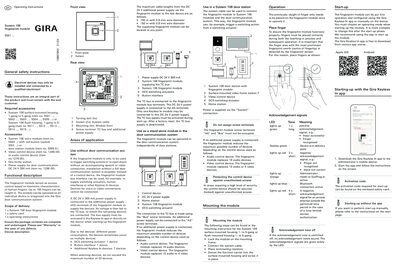
System 106 Keyless In fingerprint module
PSTI Statement of Compliance
PSTI Statement of Compliance